Biweekly vs Semi-Monthly: Same Salary, Different Life
If you are choosing between two jobs — or your employer is changing paydays — the honest answer is: neither schedule pays more. On the same salary, both deliver exactly the same money over a year. What changes is the rhythm: how big each check feels, how neatly it lines up with rent and bills, and whether you get two pleasant surprises a year or none.
That sounds small on paper — two extra checks a year — until you run a household on it. Rent is monthly, and so are most utilities, subscriptions and loan payments.
Two schedules, side by side
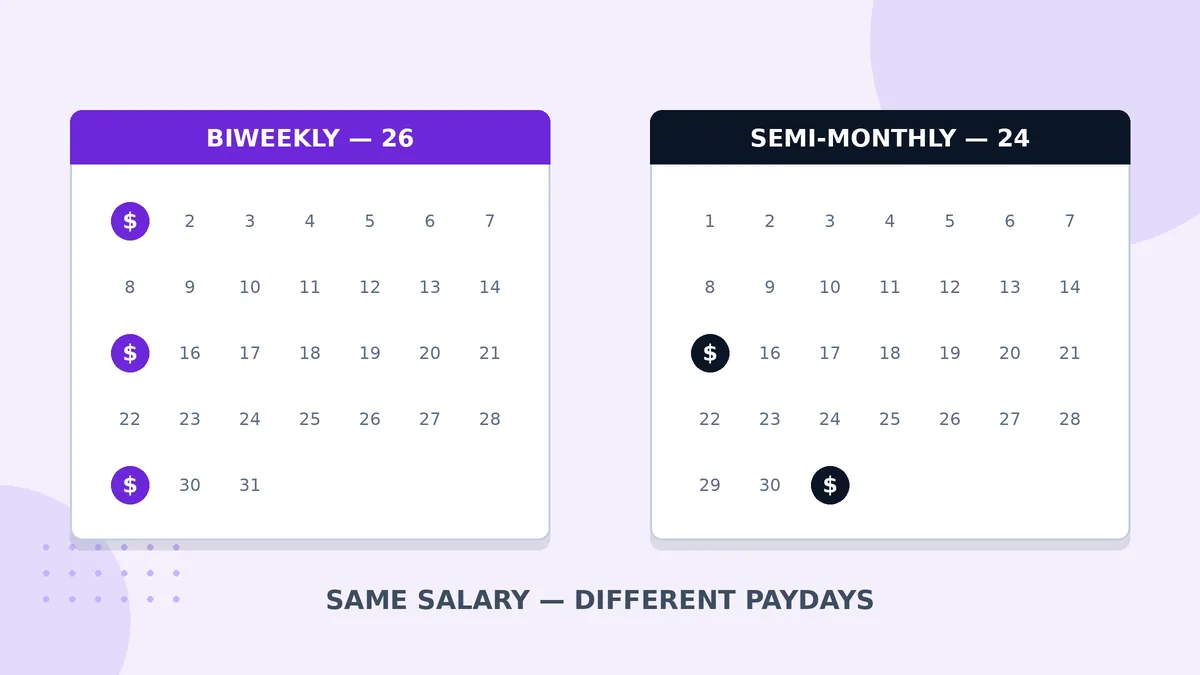
Biweekly means every two weeks, on the same weekday — every other Friday, for example. A year holds 52 weeks, so you get 26 paydays, and the date drifts through the month: the 3rd and 17th one month, the 1st and 15th another.
Semi-monthly means twice a month, on fixed dates — commonly the 15th and the last day. You get exactly 24 paydays a year, always on those dates (or the nearest business day before, if one falls on a weekend).
The arithmetic: 26 vs 24
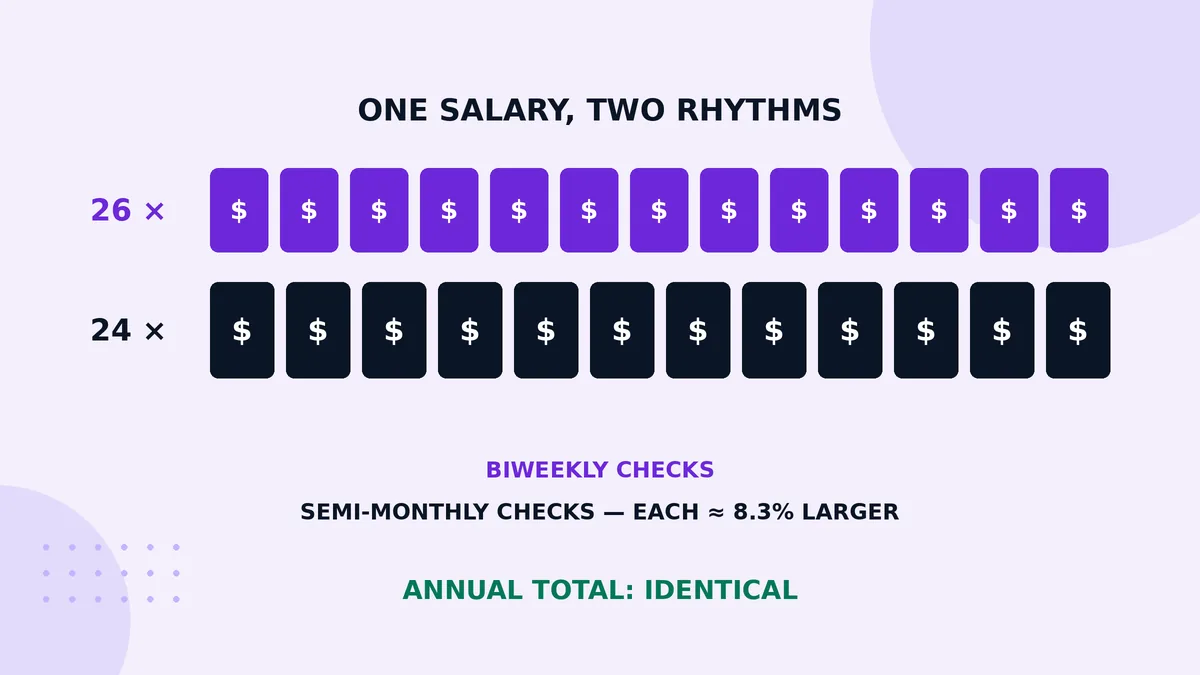
Because the same salary is split into fewer pieces, each semi-monthly check is larger. Divide 26 by 24 and you get 1.0833 — so a semi-monthly check is about 8.33% bigger than a biweekly check on identical pay. Only the slicing changes.
A worked example: $62,400 in real numbers
Take a salary of $62,400. Paid biweekly, that is $62,400 ÷ 26 = $2,400.00 per check. Most months bring two checks — $4,800 — but twice a year three land in one month, so $7,200 arrives instead.
Paid semi-monthly, the same salary is $62,400 ÷ 24 = $2,600.00 per check, and every month brings exactly two checks — $5,200, with no variation. The per-check difference is $200, that same 8.33%.
Hourly pay works the same way. At $25 an hour, full-time, a biweekly check covers a tidy 80 hours: $2,000.00 gross. Semi-monthly periods average 2,080 hours a year ÷ 24 = about 86.67 hours, so the typical check is $2,166.67 gross — bigger, but covering more days.
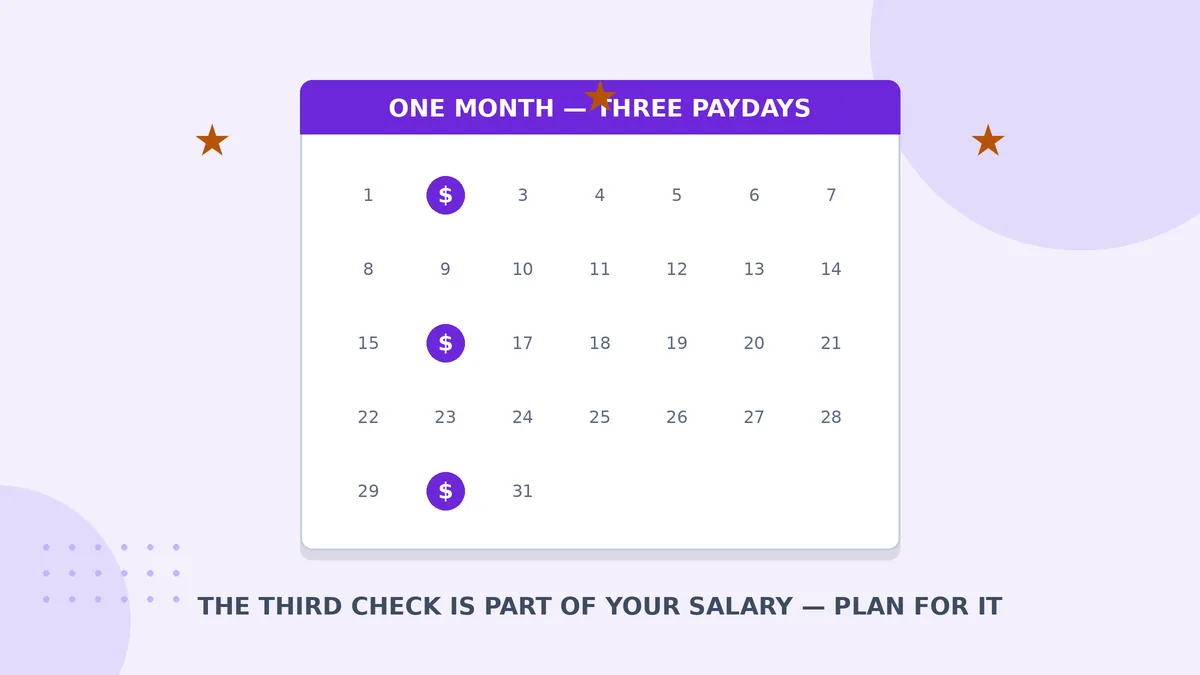
The two three-paycheck months
Since 26 checks cannot divide evenly into 12 months, biweekly pay produces two months a year with three paydays. They are not bonus money — just regular pay arriving on a schedule that ignores month boundaries. To find yours, take your first payday in January and count forward every 14 days; the two months where a third date lands are your three-check months.
Rarely, the calendar lines up so a biweekly schedule produces a 27th payday in one year — roughly once every 11 years, depending on your payday weekday. Employer handling varies: some let the extra check stand, others adjust per-check amounts so annual pay stays on target.
Budgeting on each schedule
If you are paid biweekly
Build your monthly budget on two checks only — $4,800 in the example above — and fit rent and bills inside that. Then pre-assign the three-check months before they arrive: debt payoff, annual insurance, car repairs, a holiday fund. Money already named for a job does not leak into everyday spending.
If you are paid semi-monthly
Your job is simpler and stricter. Each check is the same, and pairs naturally with half your monthly bills — first check covers rent, second covers the rest. No windfall month is coming to rescue an overspend, so a small regular transfer to savings must do that work instead.
What happens to deductions
Deductions follow the check count, and this surprises people. A health premium split per paycheck comes out 26 times a year on biweekly pay, only 24 times on semi-monthly — so the per-check amount is higher on semi-monthly, though the yearly cost is identical. A percentage-based 401(k) behaves the same: the percentage is steady, but each semi-monthly contribution is larger because the check is larger. Contribute a flat amount per check instead, and recheck your annual total after a schedule change — 26 flat contributions and 24 do not add up alike.
Switching jobs between schedules
Changing employers often means changing rhythm, and the transition can leave a gap. Most employers pay in arrears — after the period ends, sometimes a week or more later. Leave a biweekly job just after payday, start a semi-monthly job, and your first new check may not arrive until the 15th or month-end, covering only part of a period. Nothing is lost, but cash can run thin for two or three weeks. Before you switch, ask when that first payday is and what it covers.
Who uses which schedule?
Biweekly is the most common schedule in the US, especially for hourly workers, because paydays track the workweek exactly and overtime matches the hours just worked. Semi-monthly is common for salaried roles in larger organisations, where fixed dates line up with monthly accounting.
Common mistakes
Budgeting biweekly as “twice a month.” It is not — it is every two weeks. Ten months bring two checks, two bring three; a budget assuming equal monthly deposits will drift.
Forgetting deductions hit 26 times. A premium or flat 401(k) amount also leaves your pay in those two extra periods.
Reading a bigger check as a raise. Moving to semi-monthly makes each check about 8.33% larger. Your salary did not move — check the annual figure before celebrating.
Spending a three-check month twice. Counting it as found money while also relying on it for bills means the same dollars do two jobs — and one goes unpaid.
Frequently asked questions
Is biweekly or semi-monthly better for budgeting?
Semi-monthly is easier if your bills are monthly, because every month looks identical. Biweekly rewards planners: budget on two checks, and the extra checks become a built-in tool for debt, savings or annual costs.
Which months have three paychecks this year?
It depends on your payday weekday and first January payday, so there is no universal pair. Start from that first payday, add 14 days at a time, and mark the months where three dates fall.
Why is my semi-monthly check not the same in every period?
For salaried staff it usually is. For hourly staff it varies, because periods cover different numbers of days — mid-month to month-end is longer in a 31-day month than in February — so the hours differ too.
Can my employer change my pay schedule?
Generally yes, with advance notice. State payday laws still apply, governing how often you must be paid and how late pay can arrive, so expect written notice of your new dates.
Use the Pay Schedule tool to list your actual paydays for the year ahead and give any extra checks a job before they land.
List your paydays: Pay Schedule Calculator →