Overtime Pay Calculator
Calculate overtime pay at 1.5× or 2× under the federal 40-hour FLSA rule or daily-overtime state rules, and see the premium you earned.
This week's gross pay
About the Overtime Pay Calculator
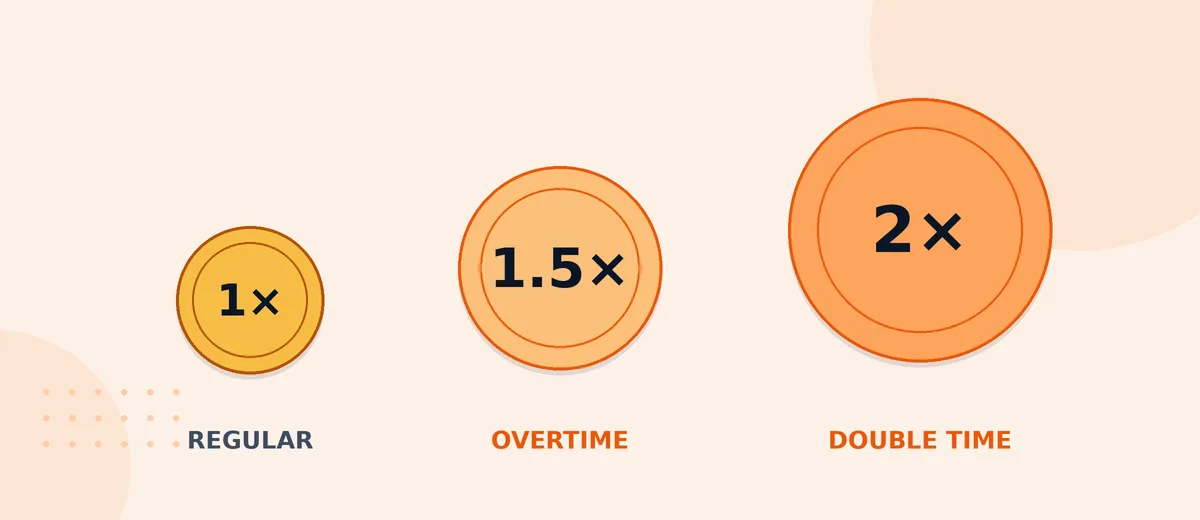
What it calculates. Your gross pay for a week that includes overtime: the regular-hours pay, the overtime hours at 1.5× (time and a half) or 2× (double time), the week's total, and — the number most people never check — the premium, meaning the extra half (or whole) rate that overtime actually added.
How the calculation works
Under the federal Fair Labor Standards Act (FLSA), non-exempt employees earn at least 1.5× their regular rate for hours beyond 40 in one workweek. The tool splits your hours at the threshold you choose: hours up to the threshold × your rate, plus hours beyond it × rate × multiplier. Some states add daily rules — California, for example, pays overtime after 8 hours in a single day and double time after 12 — so the tool offers a daily mode that assumes a 5-day week. One subtlety the law insists on: the "regular rate" must include most non-discretionary bonuses and shift differentials, not just base pay, so a stub that calculates overtime on base pay alone may be underpaying you.
Limitations & common mistakes
- Gross only. Tax is not deducted here; a heavy overtime week is also withheld as if you earned that pace all year, which is corrected at tax-return time (see the FAQ on our FAQ section).
- Averaging two weeks is not allowed. Employers may not average hours across a biweekly pay period to dodge overtime — each workweek stands alone under the FLSA.
- "Salaried" does not automatically mean exempt. Duties and pay level decide exemption, not the job title. If you are misclassified, this calculator shows what the hours were legally worth.
Overtime FAQ
- Can my employer give "comp time" instead of overtime pay?
- Private-sector employers generally cannot bank overtime as future time off in place of paying 1.5× in the period it was earned; comp time in lieu is mainly a public-sector arrangement.
- Is overtime taxed at a higher rate?
- No. There is no overtime tax bracket. Withholding on a big week can look heavier because payroll annualises that check, and any excess returns in your refund.
- What if my stub shows a different overtime rate?
- Divide the overtime line by the overtime hours. If the result is not at least 1.5× your regular rate (including differentials and bonuses in the rate), raise it with payroll in writing.
Related guide: Overtime Pay: Your Rights Under Federal Law →
Disclaimer: results are estimates for education only and are not tax, financial or legal advice. Employment-law summaries reflect the federal FLSA and cited state rules as of tax year 2026; verify your situation with your state labor agency or a qualified professional.