Gross Pay vs Net Pay: Where the Difference Goes
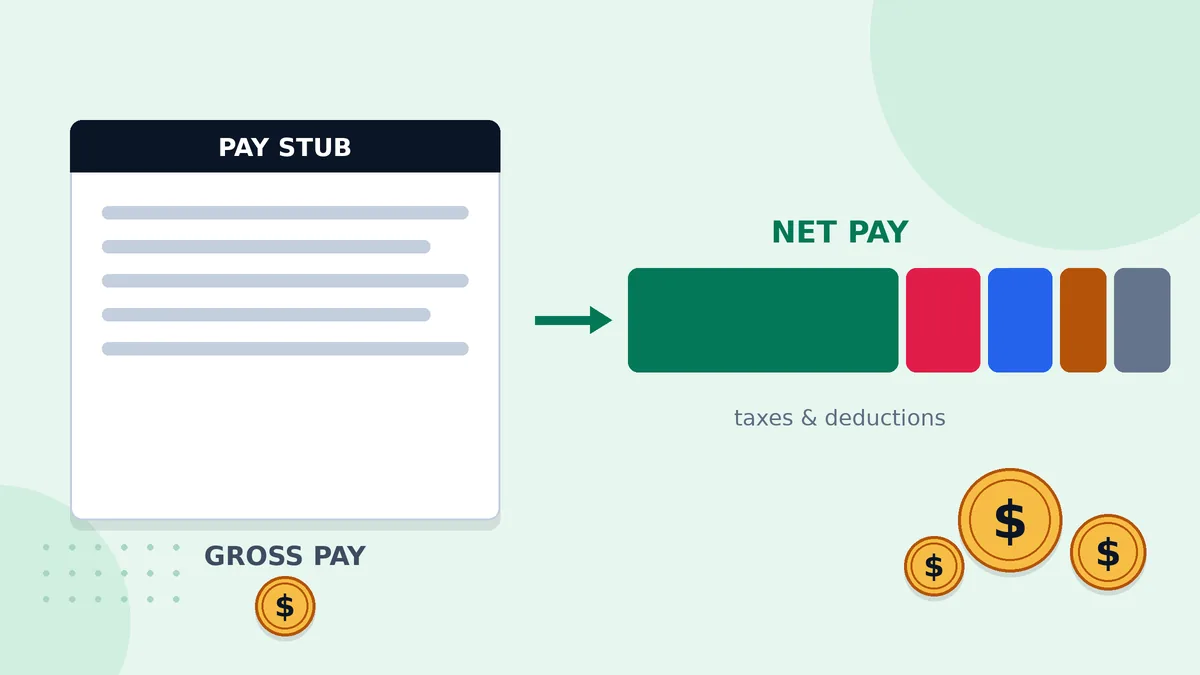
Your offer letter says $58,000. Your bank account sees roughly $45,000. Why is net pay so much less — and did payroll make a mistake? Usually not. Your pay was not cut: before it reached you, it passed through several deductions, in a fixed order. This guide traces the five stops money makes between those two numbers.
Gross pay and net pay, defined simply
Gross pay is the full amount you earn before anything is removed. Hourly, it is your rate times your hours, plus any overtime, bonuses or commissions. Salaried, it is your annual salary divided by the number of pay periods — $58,240 paid biweekly is $2,240 every two weeks, the figure in job ads and offer letters.
Net pay — "take-home pay" — is what is left after every deduction, and the amount actually deposited into your bank account. The gap is not one charge, and not money your employer keeps. It is a queue of deductions, taken in a fixed order — and that order matters, because the early stops change how the later ones are calculated.
The deduction queue, stop by stop
Stop 1: Pre-tax deductions
First come traditional 401(k) contributions and most health, dental and vision premiums. They come out before income tax is worked out, so they shrink the income the government taxes. That is why a 5% 401(k) contribution costs less than 5% of your take-home: you save, and you pay a little less tax each check.
Stop 2: Federal income tax
Next, your employer withholds federal income tax using your W-4 and the IRS percentage tables for your income and filing status. Withholding is a prepayment toward your annual bill, not the final bill: withhold too much and the excess returns as a refund; too little and you owe the difference.
Stop 3: FICA — Social Security and Medicare
FICA funds Social Security and Medicare at flat percentages, with no standard deduction. Social Security takes 6.2%, but only up to a yearly wage base — $184,500 for 2026; earn more and that 6.2% stops for the rest of the year. Medicare takes 1.45% on everything, with no cap. Your employer matches both — that match is never deducted from your pay.
Stop 4: State and local taxes
Where they apply, state and sometimes city or county taxes come next. Nine states charge no tax on earned income, so this stop takes nothing there. In states that do tax income — California, New York and Oregon are familiar examples — the bite can be several percent, withheld much like federal tax.
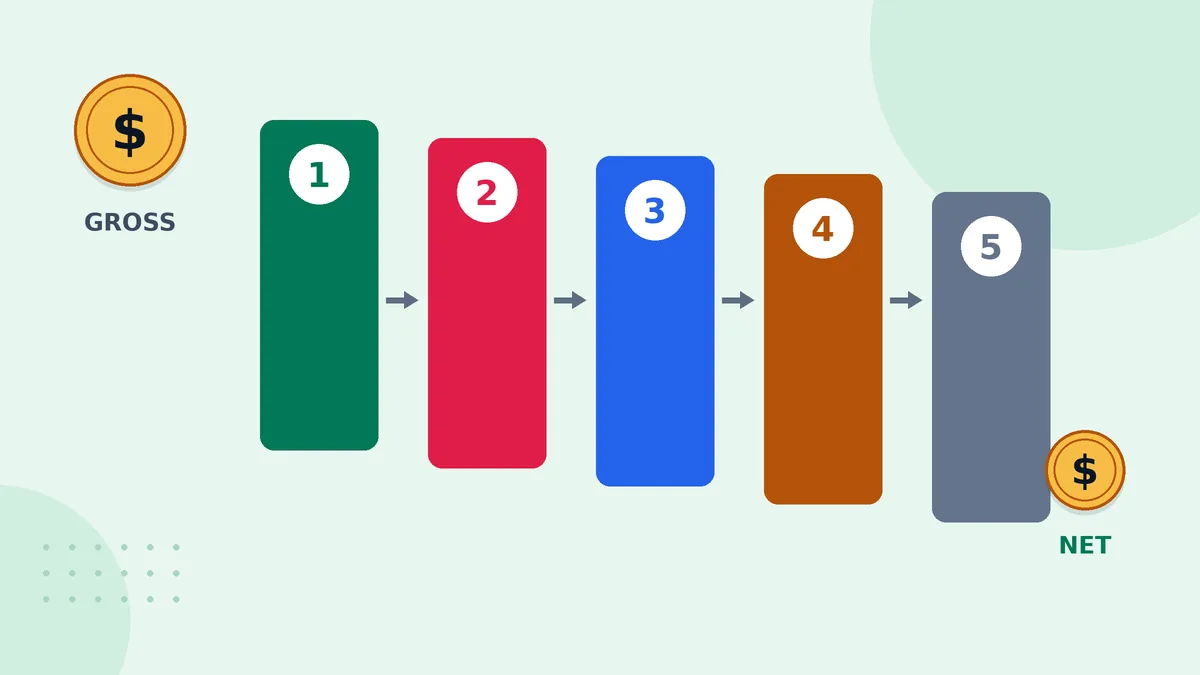
Stop 5: Post-tax deductions
Finally come deductions taken after tax, so each reduces net pay dollar for dollar, with no tax saving. These include Roth contributions, union dues, wage garnishments, parking and retirement-plan loan repayments. Some you chose, some you did not — either way, they are the last stop.
Worked example: $28 an hour in Texas
Take a worker on $28 an hour, 40 hours a week, paid biweekly, filing single, in Texas, putting 5% into a traditional 401(k), with $1,200 a year of other pre-tax deductions such as health premiums. Gross pay is $2,240.00 per check, $58,240 a year. Follow one check through the queue:
The 401(k) takes 5% of $2,240 — $112.00. The other pre-tax deductions are $1,200 over 26 checks — $46.15 per check. Annual taxable income for federal tax is $38,028, after pre-tax deductions and the $16,100 standard deduction. Federal tax on that is $4,315.36 a year, withheld as $165.98 per check.
FICA uses a wider base: a 401(k) does not escape it, while most health premiums do. FICA wages are $57,040 a year — gross minus only the $1,200. Social Security at 6.2% is $136.02 per check, $3,536.48 a year. Medicare at 1.45% is $31.81 per check, $827.08 a year. Texas state tax is $0.
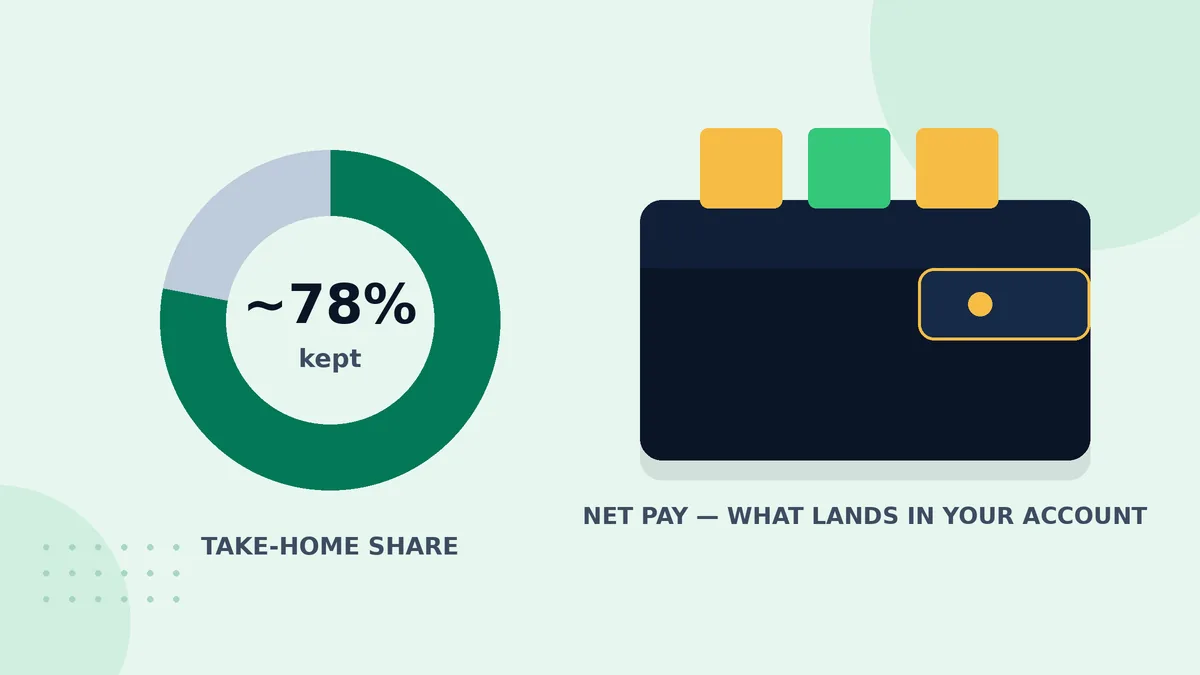
So: $2,240.00 − $112.00 − $46.15 − $165.98 − $136.02 − $31.81 = $1,748.04 net per check, $45,449 a year — about 78.0% of gross. Rule of thumb: a single filer with no state tax typically keeps 76–82% of gross; with state tax and benefits, 68–76% is normal.
Comparing job offers: gross is not the whole story
A higher salary does not always mean a higher deposit. A $62,000 offer in a taxed state with pricey premiums and no retirement match can net less per check than a $58,000 offer in a no-tax state with cheaper premiums and a 401(k) match — extra pay that never appears in the salary figure. Run both offers through a paycheck calculator and compare net per check.
Common mistakes
Budgeting on gross. Setting rent, loan payments and savings targets from your salary overruns every month, because a fifth to a third of it never reaches you. Budget from the net on a real stub.
Comparing offers on gross alone. State tax, premiums and benefits can reverse the ranking of two offers. The bigger salary is not always the bigger paycheck.
Expecting a whole raise. A $3,000 raise will not add $3,000 to your account — taxes and percentage-based deductions take their share first, so net might rise by roughly $2,100 to $2,300.
Ignoring pre-tax value. A 401(k) contribution is not money lost: it cuts today's taxable income, becomes your savings, and may attract a match. Cutting it to lift this month's net can cost far more later.
Frequently asked questions
Is net pay the same as take-home pay?
Yes. Net pay is the label payroll and pay stubs use; take-home pay is the everyday name for the same amount — what lands in your account after all deductions.
Why did my net pay change when my pay did not?
Overtime or a bonus raises gross and withholding. A new premium or changed 401(k) percentage changes a deduction. Crossing the Social Security wage base stops the 6.2% mid-year and raises net. Compare the new stub with the last one, line by line — the line that moved explains it.
Can a raise ever lower my net pay?
Not through the tax brackets: only the slice of income above a threshold is taxed at the higher rate, not all of it, so a raise still leaves you with more net. Losing a means-tested benefit outside payroll is the rare exception.
Where do I find gross and net pay on my stub?
Check the earnings and deductions summary, usually near the top. Gross pay is the period total before deductions; net pay sits in a highlighted box labelled "net pay" or "take-home," and should match your deposit. Most stubs also show year-to-date totals for both.
Run your own numbers: Paycheck Calculator →