How Federal Withholding Actually Works (W-4 Explained)
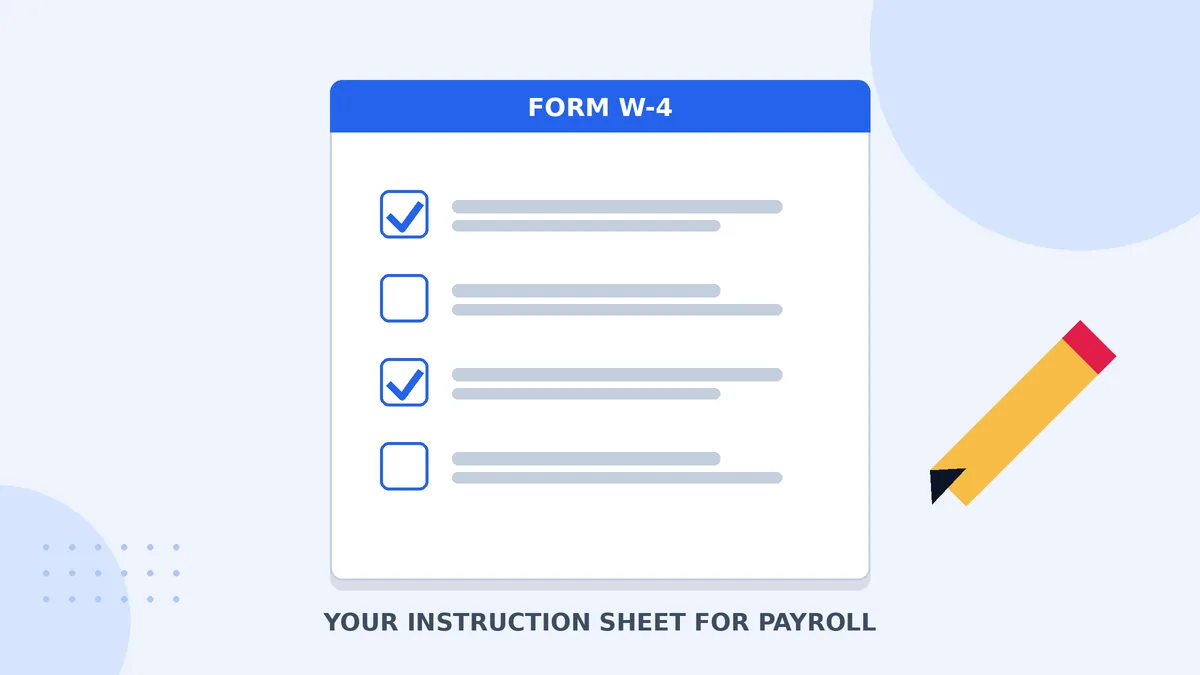
Your employer decides how much federal tax to take out by running every paycheck through an IRS formula — no guessing, no flat percentage of gross. Your Form W-4 is the instruction sheet for that formula. Get it right and each check lands close to what you actually owe.
Withholding is a prepayment, not your final tax
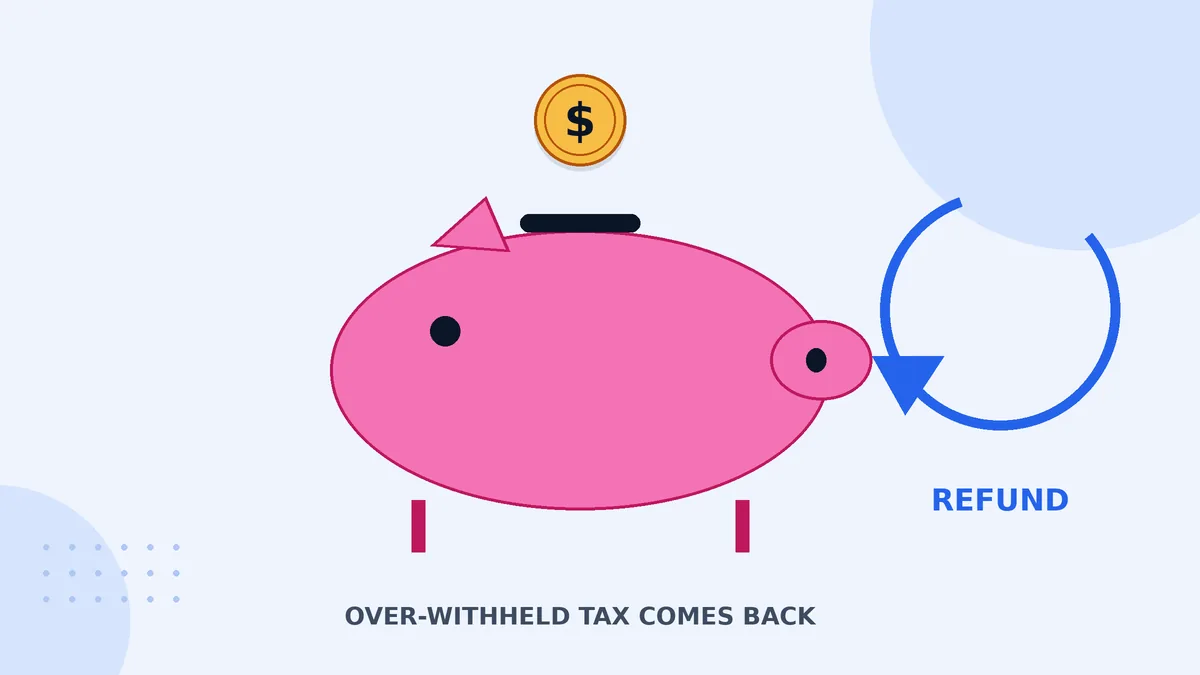
Withholding is paying your tax bill in instalments. The IRS requires tax as you earn, so your employer holds back an estimate from every check and sends it in your name. At filing, that total is credited against your real tax: too much withheld means a refund, too little means a bill, sometimes with a penalty.
The formula, step by step
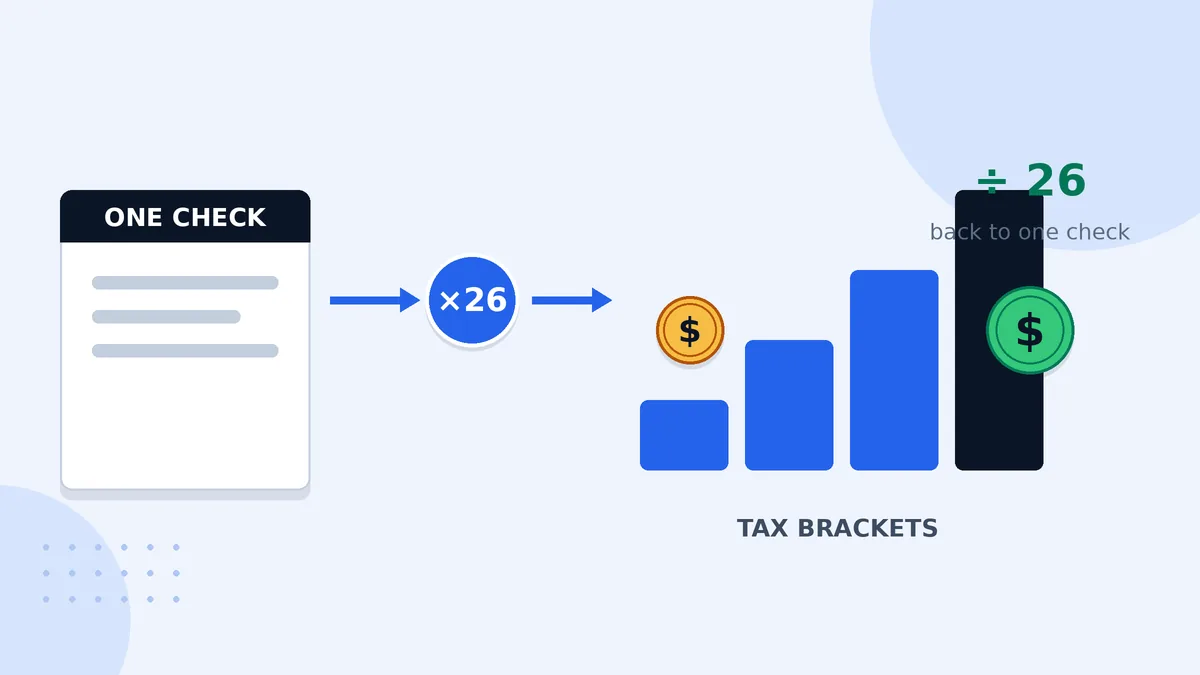
Payroll follows the same sequence every payday. First, start with gross pay. Second, subtract pre-tax deductions — traditional 401(k) contributions, health premiums, HSA amounts. Third, annualise the rest: a biweekly check is multiplied by 26, a weekly check by 52, as if earned all year. Fourth, subtract your filing status's standard deduction and apply your W-4 adjustments. Fifth, run the result through the federal brackets for an annual tax. Sixth, divide that tax back by the number of pay periods — that is the federal line on your stub.
Worked example: $28 an hour, single filer
Take a worker on $28/hour, 40 hours a week, paid biweekly, filing as single, putting 5% into a 401(k), plus $1,200 a year in other pre-tax deductions. Gross per check: $2,240.00. Pre-tax per check: $112.00 for the 401(k) plus $46.15 other — $158.15 total. Taxable per check: $2,081.85.
Annualised: $2,081.85 × 26 = $54,128.10. Subtract the 2026 single standard deduction of $16,100 and taxable income is $38,028. The 2026 single brackets give 10% on the first $12,400 = $1,240.00 and 12% on the remaining $25,628 = $3,075.36 — total annual tax $4,315.36. Divide back, $4,315.36 ÷ 26, and payroll withholds $165.98 per check.
Note the two rates: the top slice is taxed at 12%, the marginal rate, but $4,315.36 on $58,240 of annual pay is an effective rate of about 7.4% — the deduction sheltered the first chunk and the next slice was taxed at 10%.
Your W-4, step by step
Each step changes one part of that formula.
Step 1 — Filing status
Enter your details and filing status. This sets your standard deduction and bracket widths, so single, married filing jointly and head of household give different withholding from identical pay.
Step 2 — Multiple jobs or a working spouse
Complete this only if you hold more than one job, or file jointly and your spouse also works. Use the IRS estimator or tick box 2(c) if the jobs pay similar amounts. Skipping it when it applies is the most common cause of a surprise bill.
Step 3 — Dependents
Enter $2,000 per qualifying child under 17 and $500 per other dependent. These work like tax credits — payroll cuts withholding across the year because they reduce your final tax dollar for dollar.
Step 4 — Other income, deductions and extra withholding
4(a) covers income with no withholding — interest, dividends, side work — spreading its tax over your checks. 4(b) covers deductions above the standard deduction. 4(c) is the simplest fix: a fixed extra amount withheld every check.
Step 5 — Sign, or claim exempt
Sign and date it. Exempt is strict: claim it only if you had no federal tax liability last year and expect none this year. It means zero federal income tax withheld, must be renewed by February 15 yearly, and Social Security and Medicare tax still apply.
Why overtime and bonus checks look over-taxed
Annualising explains it. A check swollen by overtime is multiplied as if you earned at that pace all year, pushing part of it into a higher bracket; a bonus is withheld at the flat 22% supplemental rate. If the pace does not continue, the excess normally returns at filing — annual tax is based on annual income, not your best month.
The two-earner trap
When both spouses work, each employer runs the formula alone. If both W-4s say married filing jointly and neither completes Step 2, each job applies the married standard deduction and wider brackets — so the household claims that shelter twice and too little is withheld all year. Fix it on one W-4 only: tick box 2(c) or add an amount on line 4(c) of the higher earner's form.
Refund or bill? Reading the result
A refund is not a bonus and a bill is not a mistake — both are the settlement. But size talks. A $2,600 refund on biweekly pay is roughly $100 per check you could have had during the year; a repeated bill that size means roughly $100 per check too little taken. Aim for close to zero: enough to avoid a penalty, not so much that you lend the government money interest-free until spring.
When and how to file a new W-4
You can hand your employer a new W-4 at any time — no IRS permission, no enrolment window, no limit on changes — and most payroll teams land it within one or two cycles. Recheck yours after marrying or divorcing, a new child, a spouse starting or leaving work, new side income, or a bracket-crossing raise.
Common mistakes
Claiming exempt casually. If you owed tax last year or expect to this year, you do not qualify — the bill still comes due.
Leaving a pre-2020 W-4 untouched. It used allowances, now abolished — after marriage, children or a second income it is stale.
Both spouses skipping Step 2. Each employer shelters the same income twice, and April brings the bill.
Forgetting side income in Step 4(a). Nothing is withheld on freelance income — cover it on your main W-4 or settle it all in April.
Frequently asked questions
Why did my withholding jump in a month with overtime?
Because payroll annualised that large check and taxed part of it higher. If hours settle, later checks normalise and any excess is reconciled on your return.
Can I change my W-4 whenever I want?
Yes — hand your employer a new signed form whenever life or income changes. No reason needed, no IRS approval.
What does 'exempt' actually mean, and who qualifies?
Zero federal income tax withheld all year. You qualify only if you owed none last year and expect none this year — and you must renew it by February 15 each year.
Why is my refund so big — and is that bad?
You overpaid during the year. Not dangerous — but it is your money arriving late, without interest. Adjusting Steps 3 or 4, or reducing withholding on 4(c), moves it back into your checks.
See withholding on your own pay: Paycheck Calculator →