Why Your Bonus Check Looked So Small
You open the deposit and do the math twice. A $5,000 bonus landed as roughly $3,600 — or less — and it looks like you were taxed at 30%, 35%, even close to 40%. You were almost certainly not. What shrank the check was withholding, not your final tax. Withholding is money your employer sends to the IRS in advance, before your real bill is known. Here is where every dollar went — and how any extra comes back.
Start with the fact that calms most bonus panic: there is no special bonus tax rate. On your return, a bonus is ordinary income, just like salary. It is added to your wages and taxed in the same brackets at the same rates. Only the amount held back on payday is different — and that is what creates the sticker shock.
Withholding is not tax
Think of withholding as a deposit, not a bill. Your employer sends part of every payment to the IRS, and that money sits to your credit. Your real tax is calculated once, when you file, on all your income. If too much was sent in, you get a refund. If too little was sent in, you pay the difference. Bonus day shows only what was prepaid, not your final cost.
The two IRS methods for withholding on bonuses
Bonuses are what the IRS calls supplemental wages — pay on top of regular wages, like commissions and overtime. Employers must withhold on them using one of two approved methods. Payroll does not get to invent a third option.
The percentage method: a flat 22%
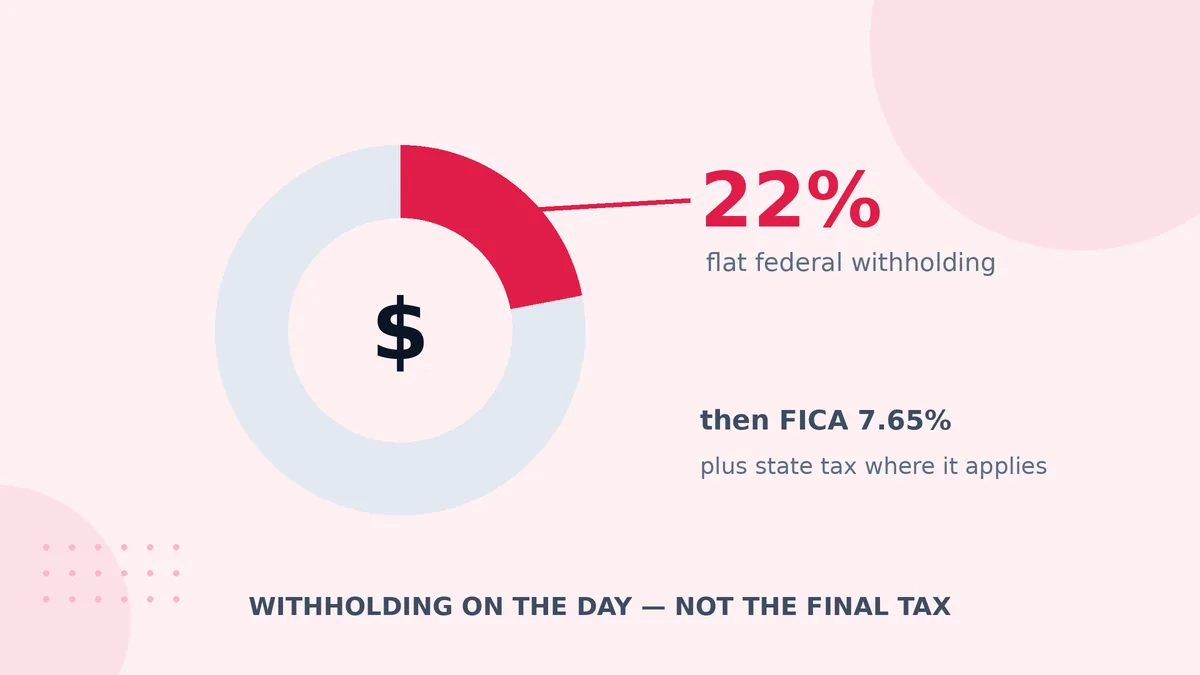
If your bonus is paid as a separate check, or is separately identified on your stub, the IRS requires a flat 22% federal withholding rate. That is why your employer cannot simply “use your normal rate” on a separate bonus check, even if you ask. The 22% is not a judgment about you; payroll applies the same rate to almost everyone. One aside: above $1 million a year, withholding on the portion over that line jumps to 37%.
The aggregate method: added to a regular check
The other option is to add the bonus to your regular wages in one combined check. Withholding is then worked out as if you earned that larger amount as normal pay for the period. Depending on your pay and pay frequency, that can withhold more or less than 22% — it is not automatically better, so run the numbers first.
Worked example: a $5,000 bonus, step by step
Say you receive a $5,000 bonus as a separate check, and your state has no income tax. Here is exactly what comes out on the day:
Federal withholding at 22%: $1,100.00. Social Security at 6.2%: $310.00. Medicare at 1.45%: $72.50. Total withheld: $1,482.50. Net on the day: $3,517.50.
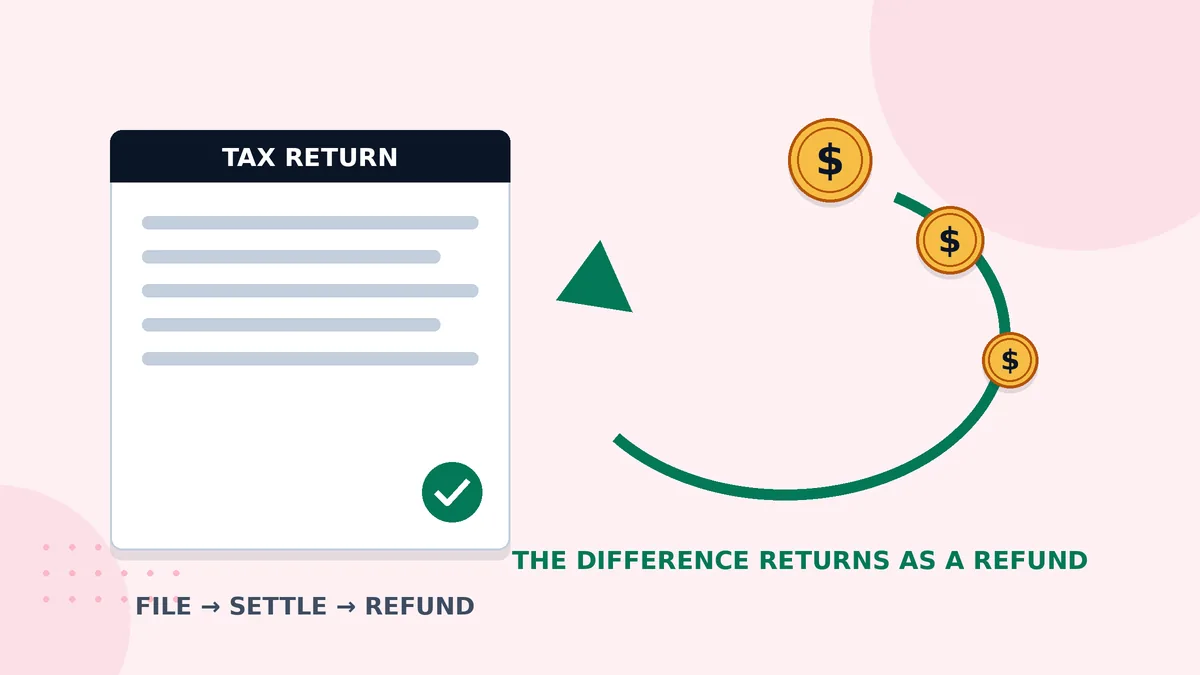
Now the filing-time half. Suppose your marginal rate — the rate on your top dollars of income — is 12%. The final federal tax on this bonus is then 12% of $5,000, which is $600. Payroll withheld $1,100, so $500 of that withholding comes back in your refund, or reduces a balance due by $500. The bonus was never taxed at 22%. It was prepaid at 22% and settled at 12%.
Where the rest goes: FICA and state tax
Federal withholding is only the biggest slice. FICA — Social Security and Medicare — takes another 7.65%, same as regular pay: 6.2% for Social Security and 1.45% for Medicare. Unlike the federal piece, FICA is a final payroll tax — it does not come back in a refund. Most states with an income tax withhold on bonuses too, each at its own rate or method. Add state tax on top and roughly 30–35% gone on the day is normal — how a 22% rate turns into talk of a “40% bonus tax.”
What happens when you file
At filing time, the bonus simply joins your wages in your total income. Your deduction, brackets and credits apply to the whole amount, not check by check. The IRS compares your total tax with everything withheld during the year, bonus included. Over-withheld, and the difference is your refund. Any refund arrives on the normal filing schedule, months later — not in the next paycheck.
What you can and cannot change
You cannot change the flat rate itself: if the bonus is a separate check, 22% federal withholding is mandatory, and FICA is never optional. Two legal levers do exist. First, ask payroll before the bonus is processed about the aggregate method. Sometimes it helps, sometimes it hurts, so ask early. Second, in bonus month you can temporarily raise your 401(k) percentage. Pre-tax contributions reduce the taxable bonus dollar-for-dollar, and you can drop the percentage back afterwards.
Four common bonus mistakes
Believing bonuses are taxed at a special, higher rate. They are not. Only the withholding is special. Your return treats a bonus dollar exactly like a salary dollar.
Turning down a bonus because of tax. A bonus always leaves you ahead. Tax takes a slice of the extra, never the whole bonus.
Expecting the difference back straight away. Over-withholding settles when you file, not when the bonus lands. Budget for the smaller deposit; treat the refund as later money.
Assuming the aggregate method is always better. Combining checks can push withholding up as easily as down. It depends on your pay and the period — check first.
Frequently asked questions
Is there a special bonus tax rate?
No. There is a special withholding rate — 22% on a separately paid bonus — but your final tax uses the ordinary brackets. For many workers the final rate is 12% or 22%, and over-withholding is refunded.
Can I ask payroll to withhold less on my bonus?
Not below the IRS rules. On a separate check, payroll must take 22% federally. Your real options are the aggregate method, a temporary 401(k) increase, or adjusting your W-4 for the rest of the year.
Why did my regular check look smaller in bonus month?
That usually means the aggregate method was used. The bonus was added to your normal pay, so the combined check was withheld as if that higher amount were your regular pay. Your next check should look normal again.
Does a bigger bonus ever leave me worse off overall?
No. Tax brackets are marginal: only the slice of income above each threshold is taxed at the higher rate, never everything you earned. A bigger bonus always means more money kept, even when part of it lands in a higher bracket.
Calculate your bonus: Bonus Tax Calculator →