Biweekly Pay: How Many Paychecks Do You Get in a Year?
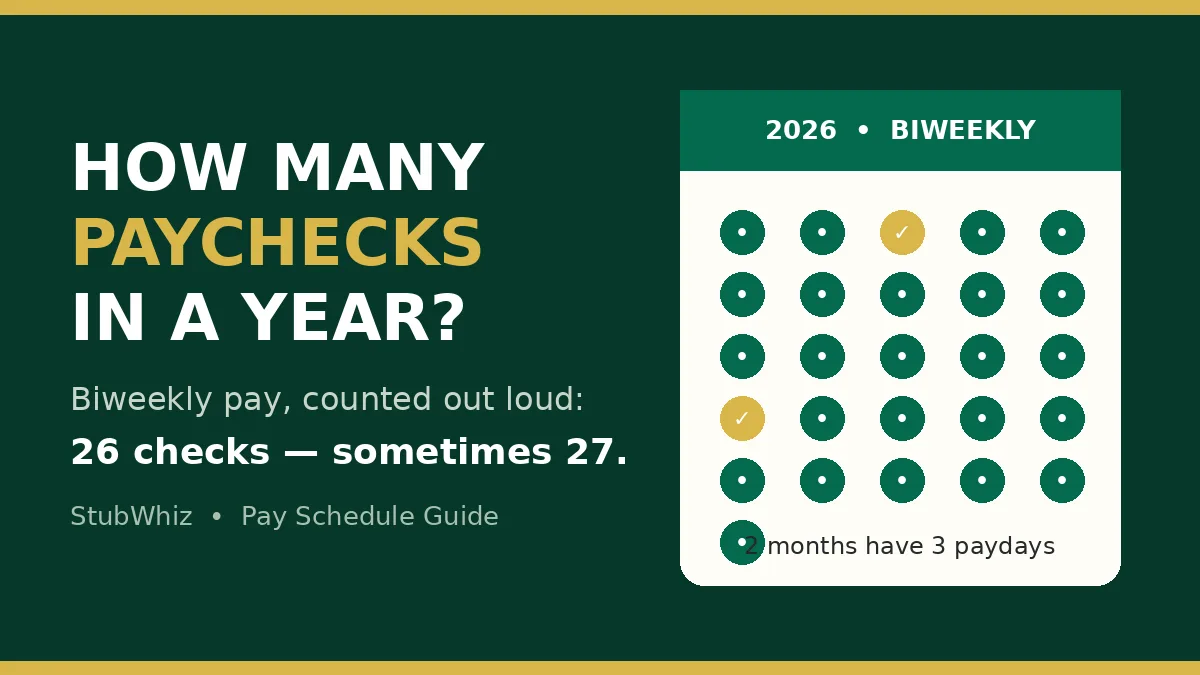
Mark every other Friday on a calendar. Most months will have two marks; twice in the year, a month will have three. That third mark is the clue — and the reason so many people miscount their own pay. If you are paid biweekly, how many paychecks in a year do you actually get? The short answer is 26 in a normal year: one every two weeks, 52 weeks divided by two. But about once every 11 or 12 years a schedule squeezes in a 27th. Below, the year is counted out loud, with the three-paycheck months and a $62,400 salary worked through every schedule — and what does not.
Count it yourself in 30 seconds
You do not need a payroll department to answer this for your own job. Take your first payday of the year, add 14 days, and keep adding 14 days until you run out of year. That is your count. The rule is the weekday, not the date: biweekly pay always lands on the same weekday, every 14 days, no matter how long or short the month is. That is also why the count is not simply two per month. Two per month for 12 months would be 24 paychecks, and that is the semi-monthly schedule, not biweekly. Biweekly has two extra checks because 26 paydays spread over 12 months cannot be split evenly: ten months get two, and two months get three.
Every schedule at a glance
| Schedule | How often | Paychecks a year |
|---|---|---|
| Weekly | Every week | 52 |
| Biweekly | Every two weeks | 26 (sometimes 27) |
| Semi-monthly | Twice a month, fixed dates | 24 |
| Monthly | Once a month | 12 |
Notice the trap in the middle of that table. Biweekly and semi-monthly sound almost the same, but they are not. Semi-monthly paydays are fixed dates, usually the 1st and 15th, so the gap between checks varies with the month. Biweekly paydays are fixed weekdays, so the gap is always exactly 14 days and the dates drift through the month. If your employer says twice a month, you get 24 checks. If your employer says every other week, you get 26.
A worked example: $62,400 on every schedule
Take a salary of $62,400 a year. The annual total never changes — only the size of each slice does:
| Schedule | Checks a year | Gross per check |
|---|---|---|
| Weekly | 52 | $1,200.00 |
| Biweekly | 26 | $2,400.00 |
| Semi-monthly | 24 | $2,600.00 |
| Monthly | 12 | $5,200.00 |
The biweekly check is $200 smaller than the semi-monthly check, but two extra checks a year exactly make up the difference: 26 times $2,400 and 24 times $2,600 both equal $62,400. Now look at the monthly-budget trap. A biweekly worker who budgets two checks a month plans on $4,800 a month, because two times $2,400 is $4,800. But the true average month is $62,400 divided by 12, which is $5,200. The $400 monthly gap adds up to $4,800 over the year — exactly two biweekly checks that were never in the monthly budget. That is why the three-paycheck months feel like bonus months: the money was always coming, it was just hidden by a two-checks-a-month budget.
Your three-paycheck months: a full 2026 calendar
Which two months get the third check depends only on your first payday. Take the common case: every other Friday, first payday Friday, January 2, 2026. The 26 paydays are January 2, 16 and 30; February 13 and 27; March 13 and 27; April 10 and 24; May 8 and 22; June 5 and 19; July 3, 17 and 31; August 14 and 28; September 11 and 25; October 9 and 23; November 6 and 20; and December 4 and 18. That is 26 checks, with three-paycheck months in January and July. A Friday schedule starting January 9, 2026 gives three-paycheck months in May and October instead, still 26 in total. To get your own list, open the Pay Schedule Calculator and enter your salary and first payday. Note: some employers take benefit deductions only 24 times a year, so a third check can be larger. Check your stub first.
When 27 paychecks happen — and what the 27th really is
Twenty-six biweekly periods of 14 days cover 364 days. A normal year has 365 days, a leap year 366, so one or two days are left over every year. Those leftovers accumulate, and roughly every 11 or 12 years they add up to a full extra period. Whether a particular year is a 27-paycheck year for you depends entirely on your anchor weekday. A schedule anchored on Thursday, January 1, 2026 fits 27 paydays into 2026, with the last on December 31. A Friday schedule starting January 2, 2026 fits only 26, while the same Friday pattern starting January 1, 2027 fits 27 into 2027. What the 27th check means depends on how you are paid. If an employer divides a $52,000 salary by 26, a 27th check at $2,000 is $2,000 more gross pay that year. If the employer divides by 27, each check falls to $1,925.93 and the annual total stays $52,000. For an hourly worker, a 27th period simply pays for hours worked in that period. Either way, it is calendar arithmetic, not a raise.
Common mistakes that miscount the year
Calling biweekly twice a month. Twice a month is semi-monthly: 24 checks on fixed dates. Biweekly is every two weeks: 26 checks on a fixed weekday. Using the wrong label gives you the wrong count by two checks.
Budgeting two checks every month. That understates the year by two checks, or $4,800. Budget on the true monthly average — annual pay divided by 12 — and treat the third checks as planned income, not surprise money.
Assuming the 27th check is free money. For salaried workers it depends on whether the employer divides by 26 or 27; for hourly workers it pays for hours worked. Ask payroll which method your employer uses before counting it.
Forgetting holiday shifts. A payday on a bank holiday is often paid the working day before, which can move a check into a different month on paper without changing the yearly count.
Frequently asked questions
How many paychecks in a year if paid biweekly?
26 in a normal year, one every two weeks. About once every 11 or 12 years a particular schedule produces 27, depending on its first payday.
How many paychecks in a year if paid semi-monthly?
Exactly 24, two on fixed dates each month.
How many three-paycheck months are there in a year?
Two in a normal 26-check year, and three in a 27-check year. Which months they are depends on your first payday — for a Friday schedule starting January 2, 2026, they are January and July.
Is biweekly pay better than semi-monthly pay?
The annual total is the same. Biweekly checks are smaller but more frequent, unless an employer divides a salary by 26 in a 27-check year, when the extra check is real additional gross pay.
Run your own year: Pay Schedule Calculator → · Related reading: Biweekly vs Semi-Monthly: Same Salary, Different Life