How Much Is $25 an Hour Annually (Before and After Tax)?
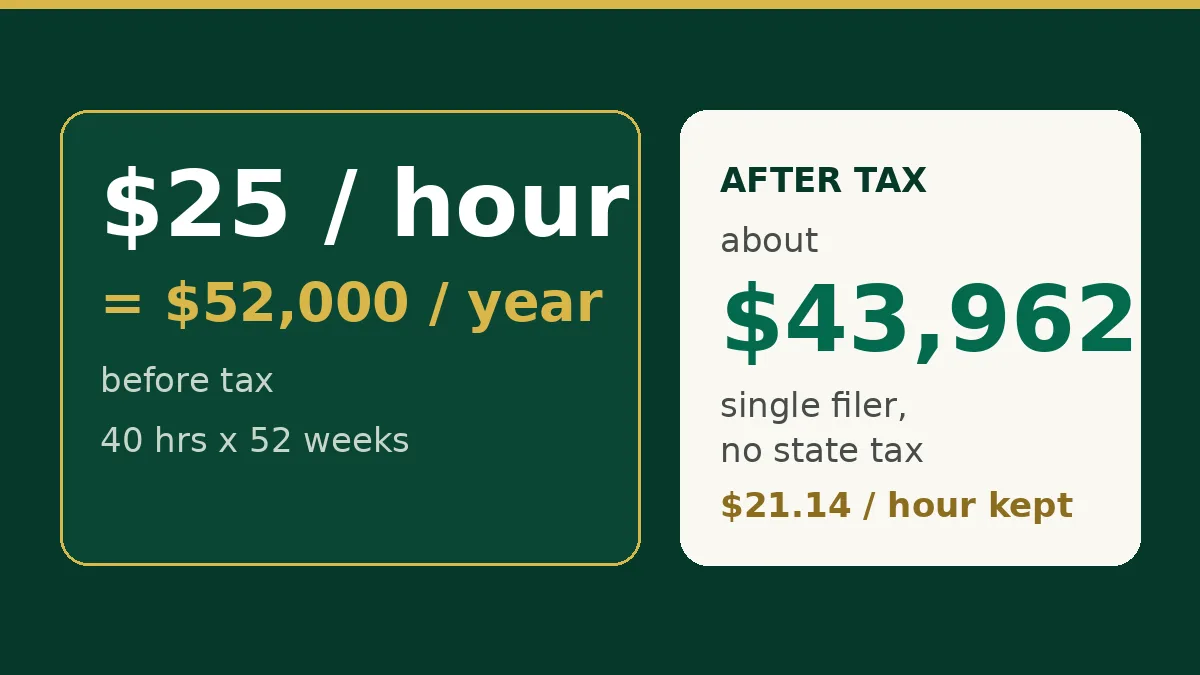
$25 an hour is $52,000 a year before tax on a full-time schedule — 40 hours a week, 52 weeks a year, or 2,080 hours in total. After federal income tax and FICA, a single filer with no state income tax and no pre-tax deductions keeps about $43,962 of it: roughly $3,663.50 a month, $1,690.85 every two weeks, and $21.14 for each hour actually worked. The rest of this guide shows exactly where the $8,038 difference goes, and why your own figure may land higher or lower.
The gross figure first: $52,000, broken down
The conversion behind every number in this guide is simple multiplication. An hourly rate becomes an annual salary by multiplying it by the hours you work in a year, and the standard full-time assumption is 2,080 hours (40 × 52). Here is what $25 an hour looks like at each common pay rhythm, before a single deduction:
| Pay period | Gross pay |
|---|---|
| Per hour | $25.00 |
| Per day (8 hours) | $200.00 |
| Per week (40 hours) | $1,000.00 |
| Biweekly (80 hours) | $2,000.00 |
| Per month (annual ÷ 12) | $4,333.33 |
| Per year (2,080 hours) | $52,000.00 |
Note the monthly figure: $4,333.33 is the annual salary divided by twelve, not four weekly checks, which add up to only $4,000 — most months contain slightly more than four weeks. Budget from the monthly average, not from a single check.
One warning: $52,000 assumes you are paid for all 52 weeks. Two unpaid weeks off mean 50 paid weeks and a gross figure of $50,000 (25 × 40 × 50). Check whether an offer counts time off as paid.
After tax: about $43,962 in the worked example
Tax does not take a flat slice of your pay, so the after-tax figure needs real arithmetic rather than a guessed percentage. Using the site's 2026 figures — the $16,100 standard deduction for a single filer, the 2026 federal brackets, and FICA at 7.65% — a single filer in a state with no income tax, with no 401(k) or health-premium deductions, lands here:
| Line | Annual amount |
|---|---|
| Gross pay | $52,000.00 |
| Federal income tax | −$4,060.00 |
| Social Security (6.2%) | −$3,224.00 |
| Medicare (1.45%) | −$754.00 |
| State income tax (Texas) | $0.00 |
| Net (take-home) pay | $43,962.00 |
That is 84.5% of gross pay kept — a high share, because this example has no state tax and no benefit deductions. Add either and the kept share falls.
The worked example, line by line
Take a single filer on $25 an hour, 40 hours a week, paid biweekly, in Texas, with no pre-tax deductions. One biweekly check carries $2,000 of gross pay. Over the year the arithmetic runs like this. First, the standard deduction: $52,000 minus $16,100 leaves $35,900 of taxable income for federal tax. The 2026 single brackets tax that in slices — the first $12,400 at 10% is $1,240, and the remaining $23,500 at 12% is $2,820 — for a federal bill of $4,060 for the year, or $156.15 per biweekly check.
Next, FICA, which has no standard deduction and applies to the full $52,000: Social Security at 6.2% is $3,224 a year ($124.00 per check) and Medicare at 1.45% is $754 ($29.00 per check). Texas state tax is zero. The three deductions total $8,038, leaving $43,962 of take-home pay: $1,690.85 per biweekly check, $845.42 per week, $169.08 per day, and $21.14 per hour worked.
Why your number will differ
Your hours. The $52,000 figure is a 40-hour figure. At 35 hours a week the gross annual figure is $45,500, and at 30 hours it is $39,000 — same rate, very different year. Part-time workers should never annualise a rate at 40 hours they do not work.
Overtime. Hours over 40 in a workweek are usually paid at time-and-a-half — $37.50 an hour at this rate — so a regularly overtime-heavy schedule earns more than $52,000. The net gain is smaller than the gross gain, since withholding rises too.
State tax. Nine states charge no tax on earned income, and Texas is one of them. In a state that does tax income, an extra line appears in the table above and take-home pay falls by that amount. Run your state through the Paycheck Calculator rather than guessing the rate.
Filing status. A married couple filing jointly gets a $32,200 standard deduction instead of $16,100, so on the same $52,000 their federal tax would be $1,880 rather than $4,060, and their take-home would be $46,142. Filing status alone moves the answer by more than $2,000.
Pre-tax deductions. A 401(k) or health premium lowers the income federal tax is calculated on, but a 401(k) does not escape FICA, while most health premiums do. That is why two workers on $25 an hour can take home different amounts from identical gross pay.
Common mistakes
Budgeting on $52,000. Rent, loan payments and savings set from the gross figure overrun every month, because roughly $8,000 of it never reaches you in the baseline example — and more, once state tax and benefits join in. Budget from a real net figure.
Treating $25 an hour as a salary. An hourly rate is not an annual income until you know the hours. A $25-an-hour job at 32 hours a week pays less over a year than a $22-an-hour job at 40 hours. Always compare hours alongside rates.
Forgetting unpaid time off. Two unpaid weeks cut $2,000 off the year at this rate. Ask whether time off is paid before you accept a headline hourly figure as an annual one.
Comparing offers on the rate alone. A higher hourly rate in a taxed state with expensive premiums can net less per check than a lower rate in a no-tax state with cheap benefits. Compare net per check, not the number on the job ad.
Frequently asked questions
How much is $25 an hour per year after tax?
About $43,962 for a single filer with no state income tax and no pre-tax deductions, using 2026 federal figures. With state tax or benefit deductions, the figure is lower — run your exact situation through the Paycheck Calculator.
How much is $25 an hour biweekly after tax?
$1,690.85 per biweekly check in the worked example above ($2,000 gross minus $309.15 of federal tax and FICA). Your check will differ if you have state tax, a 401(k), or health premiums.
Is $25 an hour a good wage?
It depends on where you live. At $52,000 gross it sits well above a full-time minimum-wage income, but in a high-rent city it can still feel tight — which is why the after-tax monthly figure, $3,663.50 here, matters more than the hourly rate when you judge an offer.
What if I work part-time at $25 an hour?
Multiply your actual weekly hours by 52, then by $25. At 30 hours a week that is $39,000 gross a year; at 20 hours it is $26,000. The same federal and FICA rules then apply to that lower gross figure, with a smaller tax bill because taxable income is lower.
Run your own numbers: Hourly ⇄ Salary Calculator → and Paycheck Calculator → · Related reading: Gross Pay vs Net Pay